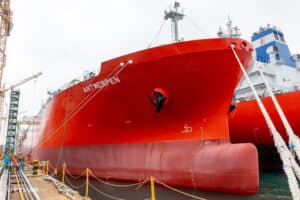
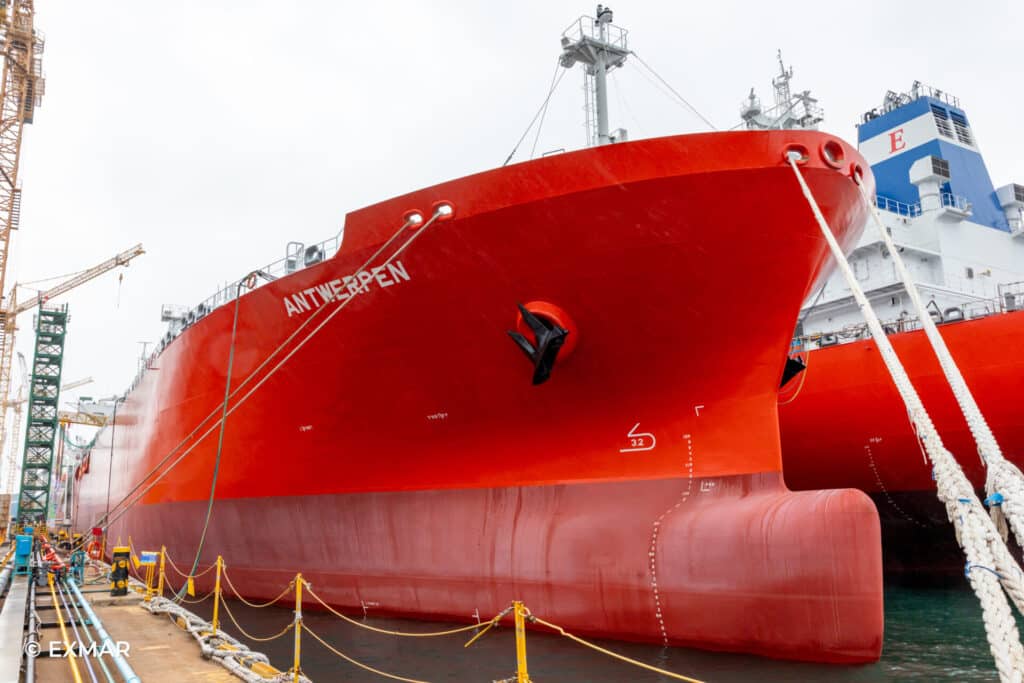
With the delivery of the Midsize Gas Carrier ANTWERPEN EXMAR is proud to say that this marks a very important milestone in low-carbon shipping. ANTWERPEN is the world’s first oceangoing vessel capable of transporting ammonia as well as using it for propulsion. The dual-fuel capability allows the vessels to operate on both conventional fuel and ammonia, providing operational flexibility while delivering significant emissions reductions. This technological improvement can lead the way to future, more sustainable shipping, for all who will choose for ammonia.
Ammonia as renewable energy source
Beyond its role as a marine fuel, ammonia has the potential to support the decarbonization of a wide range of industries, including power generation, manufacturing, and transportation. By enabling the large-scale distribution of clean hydrogen, ammonia can play a key role in reducing global carbon emissions and accelerating the transition to a lower-carbon economy.
Ammonia is one of the most effective carriers of hydrogen, making it possible to transport renewable hydrogen safely and efficiently over long distances. This enables clean energy produced in one part of the world to be delivered and used in another, helping to make sustainable fuels available on a global scale.
While ANTWERPEN is a gas carrier, the knowledge, technology, and operational experience gained from this vessel type will help accelerate the adoption of ammonia as a marine fuel across the wider shipping industry. The lessons learned can be applied to many other vessel types, supporting the transition to cleaner and more sustainable maritime transportation worldwide.
ANTWERPEN, together with her sister vessels and future ammonia dual-fuel midsize gas carriers, has been designed to significantly reduce greenhouse gas emissions. When operating on ammonia fuel, these vessels can achieve up to 90% lower emissions compared to conventional ships, enabling them to meet and exceed both current and future international environmental regulations.
Innovating at heart
EXMAR is a global leader in maritime transport and infrastructure of liquefied gasses (LPG, LNG and NH3). The company is reputed for its innovative mindset to improve the energy value chain. Such recent innovations include floating storage and regasification units (FSRU), the world’s first LPG dual fuel vessels and pioneering with Ship-to-Ship (STS) transfers at sea, barge based liquefaction terminals and leveraging eco-designs and alternative fuel technologies.
As the International Maritime Organization (IMO) started working towards a net zero future for hydrocarbon emissions, EXMAR wanted to be ahead. With over forty years of experience and more than 100 million tons transported ammonia and other liquified gasses, the company started thinking about the possibilities of ammonia as a fuel. That way, the company could be using the cargo as fuel for propulsion.
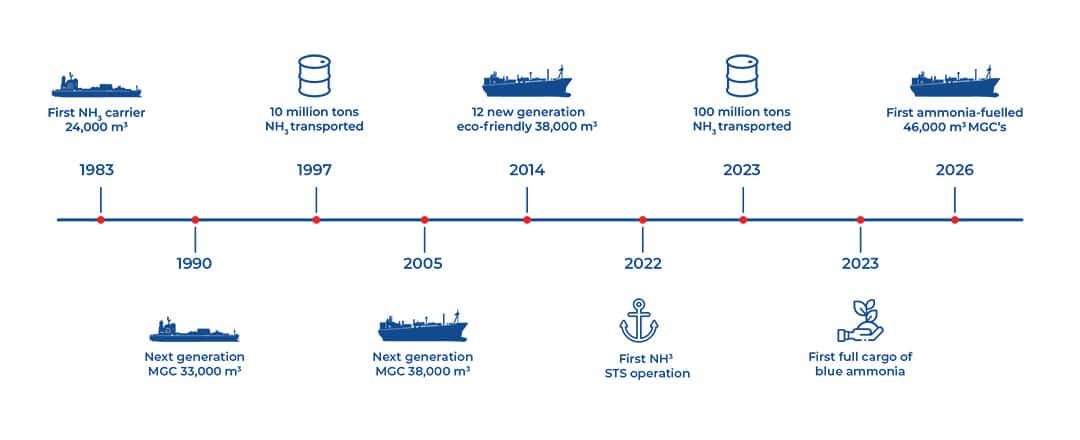
In 2021, a collaboration was launched with a major ammonia producer to develop one of the world’s first ammonia-fueled oceangoing vessels, marking an important milestone in the maritime industry’s decarbonization journey. In the same year, EXMAR received an ‘Approval in Principle’ from Lloyd’s Register for an ammonia-fueled midsize gas carrier, demonstrating the technical feasibility and safety of ammonia as a marine fuel. Together, these achievements established a clear pathway for reducing greenhouse gas emissions from shipping while supporting international climate objectives. They also accelerated the development of the technologies, infrastructure, and regulatory framework required for ammonia-fueled vessels. The knowledge and experience gained continue to contribute to the wider adoption of ammonia as a clean fuel across the global maritime industry.
Jan Joensen, Lead Surveyor, Lloyd’s Register, said: “It is a pleasure to mark the delivery of ANTWERPEN, a landmark vessel and a significant step forward for ammonia dual-fuel technology. This achievement reflects the strong collaboration and commitment across all partners involved in bringing this pioneering project to life.
“I would like to extend a sincere thank you to everyone across Lloyd’s Register and our partners for their contribution, professionalism and dedication throughout. It has been a privilege to be part of this project.”
Peter Claeyssens, Director General Shipping at FPS Mobility and Transport: “Ammonia-powered ships are an important step toward a sustainable future. We are pleased that, as a Belgian flag administration, we have been able to contribute, together with EXMAR and Lloyd’s Register, to a robust safety framework for this new technology.”
Joint development program
EXMAR set out to seek a partner who would be capable of bringing the world’s first oceangoing ammonia-fueled vessels on the market, actively staying ahead of the curve and offering a solution to the then tightening environmental regulations of the IMO.
In 2022, EXMAR launched a Joint Development Project (JDP) with HD Hyundai Mipo (now merged into HD Hyundai Heavy Industries) and leading industry partners including WinGD, Nord Gas Solutions (formerly Wärtsilä Gas Solutions), and Lloyd’s Register. Together with EXMAR’s in-house experts, the partners developed the design of an ammonia-fueled midsize gas carrier, building on decades of experience with LNG and LPG as marine fuels.
“We take great pride in building the world’s first ammonia-fueled vessel, which requires a high level of technological expertise,” said Joo Wonho, President of HD Hyundai Heavy Industries and Head of Naval & Medium-size shipbuilding business unit. “We will continue to solidify our leadership in the global eco-friendly shipbuilding market through relentless technological innovation.”
“We are proud to be part of delivering the world’s first ammonia-fuelled ocean-going vessel, a landmark achievement made possible through an intensive and highly collaborative development effort. By bringing together expertise from across the maritime value chain, we have demonstrated that ammonia propulsion can move from concept to commercial reality through safe, reliable and fully automated engine technology.” – Sebastian Hensel, Vice-President Research & Development, WinGD
“We are proud to be part of this pioneering project initiated and successfully completed by EXMAR. The collaborative journey of developing and integrating the complete system for operating vessels with ammonia as fuel has generated valuable knowledge and experience for all participants involved. The fuel supply system delivered by Nord Gas Solutions is designed to handle both ammonia and LPG as fuel, providing significant operational flexibility. EXMAR has set a forward-looking, environmental focused direction for the industry – one that many others are expected to follow.” – Stein Thoresen, Head of Sales, Nord Gas Solutions (Formerly Wärtsilä Gas Solutions)
While LNG and LPG present challenges related to flammability, ammonia introduces a different challenge due to its toxicity. Extensive safety studies, hazard identification exercises, and risk assessments were therefore carried out throughout the design process, with the safety of seafarers remaining the highest priority. Drawing on EXMAR’s long-standing experience in transporting ammonia safely as cargo, the vessel design incorporated multiple layers of protection and industry-leading safety standards, with each partner contributing expertise in its respective field.
This pioneering collaboration ultimately resulted in the construction of four ammonia dual-fuel midsize gas carriers. ANTWERPEN is the first vessel in this series to be delivered, representing a major milestone in the transition towards lower-carbon shipping and the practical use of ammonia as a marine fuel.
International safety framework
Technology alone is not enough to introduce a new marine fuel. Safe operation must requires an appropriate regulatory framework. When EXMAR began its ammonia fuel journey, existing international regulations did not permit toxic cargoes such as ammonia to be used as fuel on gas carriers. Working closely with the Belgian administration and Lloyd’s Register, EXMAR played a pioneering role in establishing an international safety framework and regulations to allow ammonia’s use as marine fuel on gas carriers. Thanks to EXMAR’s expertise, this significant change is opening new possibilities for sustainable shipping. This milestone signals the start of a new fuel era in shipping, positioning EXMAR at the forefront of sustainable maritime innovation.
To support the safe introduction of ammonia as a marine fuel, EXMAR has also developed a comprehensive in-house ammonia training program for seafarers and shore-based personnel. The program focuses on the safe handling, operation, and management of ammonia-fueled vessels and builds on EXMAR’s extensive operational experience with ammonia transportation. In addition to training its own personnel, EXMAR also makes this expertise available to third parties, helping to support the wider adoption of ammonia across the maritime industry.
About the vessels
Theses dual ammonia-powered dual-fuel midsize gas carriers can each transport over 46,000 cubic meters of ammonia and LPG. The vessel can use conventional fuel or ammonia for its propulsion.
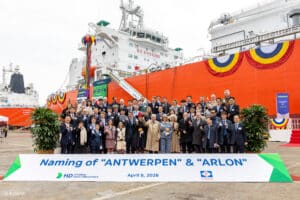
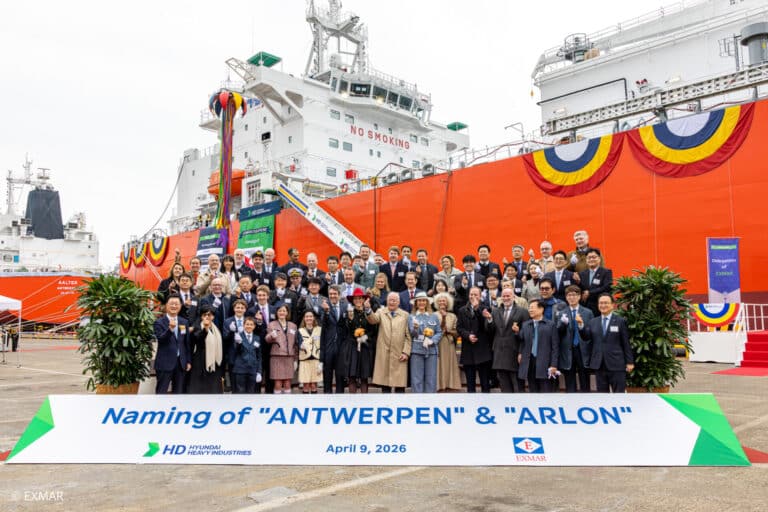
As per EXMAR’s tradition, each ship in the series of four will be named after a Belgian city, starting this time with the letter A for ammonia. After ANTWERPEN, the second ship was named ARLON. The name giving and delivery of the 3rd ammonia-dual fuel Midsize Gas Carriers will take place in the coming months. The fourth vessel is scheduled for delivery early 2027. All vessels will be owned by EXMAR LPG France.
The successful delivery removes a major barrier to ammonia-as-fuel adoption in shipping: proof of commercial readiness.
Questions about ammonia?
Read our frequently asked questions.
More about the EXMAR’s ammonia dual-fueled ships:
- Unlock ammonia’s potential with our dedicated training program
- Impressive sights at HD Hyundai Mipo in South-Korea
- Presenting World’s First Ocean-going Ammonia Dual-fueled Ships at IMO’s MEPC 82
- Steel cutting of the world’s first ocean-going ammonia dual fueled ship
- World-first type approval and factory acceptance testing for ammonia-fueled two stoke engine
- World’s first ocean-going ammonia dual-fuel vessels named in South-Korea
Delivery of ANTWERPEN marks the beginning of a new fuel era in the maritime industry